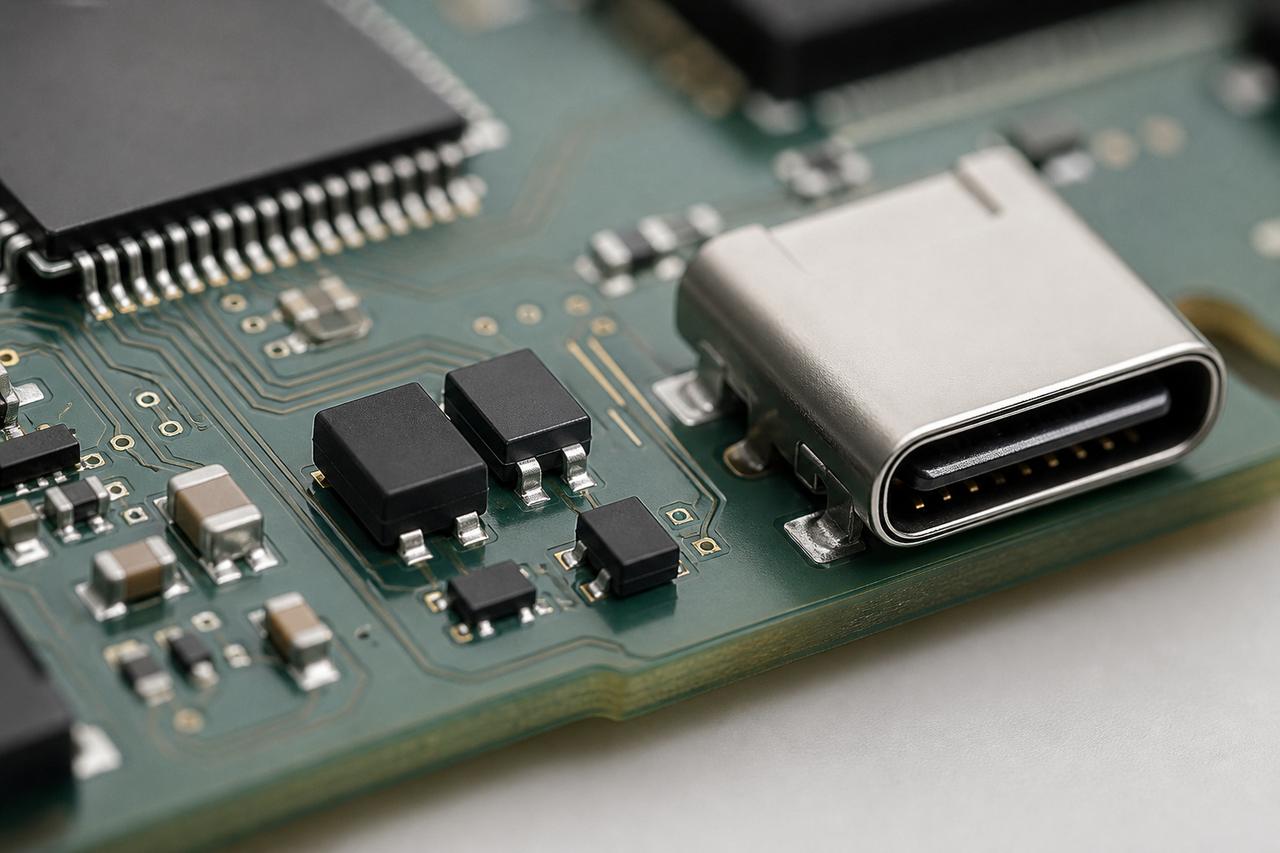
Protection parts fail quietly when selected only by voltage
OEM boards fail ESD or surge tests when TVS devices are undersized, too capacitive, or placed too far from the connector.
A clear selection method — voltage, clamp, capacitance, package — improves first-pass success on USB-C, CAN, and DC rails.
Selection matrix by application
| Application | Priority | Watch-out | Typical package |
|---|---|---|---|
| USB / high-speed | Low capacitance | Signal integrity | Small SOD / DFN |
| CAN / industrial I/O | Robust ESD | Common-mode noise | SOT / SMB |
| DC power rail | Surge energy | Clamp vs IC abs max | SMB / SMC |
| Battery / adapter | Reverse / surge | Thermal derating | Power packages |
Three numbers every datasheet must answer
Working / standoff voltage
Stay above normal operating peaks including tolerance and ripple.
Clamping voltage at relevant current
Confirm the clamp stays inside the protected IC absolute maximum at your surge or ESD current level.
Capacitance for the signal class
Match capacitance to the interface budget; otherwise eye diagrams and EMC margins suffer.
Layout habits that improve clamp performance
- Keep TVS-to-connector traces short.
- Provide a low-inductance ground return.
- Avoid sharing long loops with quiet analog grounds.
- Re-check after connector or shield changes.
Continue on ChipNobo
Open TVS Diodes and ESD Protection families to filter packages and ratings, then request samples for your interface standard. For lifecycle risk on mature protection parts, pair this with ChipNobo Engineering & Supply guidance.
FAQ
What is a TVS diode used for?
A TVS diode clamps transient overvoltage from ESD, surge, or inductive kick, protecting ICs on interfaces and rails.
How do I choose working voltage for a TVS?
Select standoff voltage above the normal rail maximum, and confirm clamping stays below the protected IC absolute maximum.
Why does capacitance matter on high-speed lines?
Excess capacitance can distort USB, HDMI, or RF edges. Prefer low-capacitance TVS or ESD arrays for data lines.
Should power rails and data lines use the same TVS?
Usually no. Power rails need surge energy handling; data lines need low capacitance and tight ESD response.
Where should TVS parts be placed on the PCB?
Place them close to the connector or entry point with short return paths to the protection ground reference.
Does ChipNobo provide TVS and ESD catalog families?
Yes. Browse TVS Diodes and ESD Protection under Protection Devices, then filter by package and ratings.
How do I start a protection design-in with ChipNobo?
Identify the interface standard and rail voltage, open the matching protection family, and request samples after parametric shortlist.